Tag: blindness

  • Are Ray-Ban Meta Smart Glasses Useful for Blind People?

    Are Ray-Ban Meta Smart Glasses Useful for Blind People?

    So are Ray-Ban Meta smart glasses useful for blind people? For me, yes. For everyone, no.

    A quick heads-up: this post contains an affiliate link to the glasses. If you buy through it, I may earn a small commission, at no extra cost to you.

    I did not buy the Ray-Ban Meta smart glasses because I needed another device. I very much did not.

    But I work in blindness software and technology, and smart glasses kept coming up after the NFB and ACB summer 2025 conventions. My curiosity had been piqued.

    Sighted people may not realize this, but blind people use cameras all the time. Usually, the camera is how I show the AI or a human helper what I need help seeing.

    My phone can already read text, describe images, and connect me to a human visual interpreter.

    The problem is sometimes the phone itself. Holding it. Aiming it. Keeping the label in frame. Trying to do all of that while cooking, standing in the chicken coop, or holding an uncooperative animal.

    Trying to film often means propping my phone somewhere stupid. Reading a label can mean holding the item in one hand, aiming the phone with the other, and hoping the camera is pointed at the label.

    Where They Earn Their Place

    I use them for reading food labels and checking chicken feed or supplement labels. I use them for quick photos, AI descriptions, and short video clips. I bought them for accessibility. Content creation came way later.

    The built-in AI descriptions are useful, but I do not treat them as final. AI can describe the scene and still miss the point.

    Lately I’ve been experimenting more with live AI because I can interrupt it, ask follow-up questions, and push it toward the part I actually care about.

    When accuracy matters, I use Aira through the glasses. In an airport, I want a human visual interpreter helping me move through the space, not AI vaguely describing signs.

    The Glasses Part Still Matters

    The frames are comfortable, but they are still glasses. I can wear them for a couple of hours, but I do not forget they are on my face.

    I would not talk someone into these if they already hate wearing glasses, already have a phone setup that works, or do not want another thing to charge. They are not cheap, so it’s worth considering if you’ll use them or not.

    Initially, I stressed more than I needed to about the lenses. Clear? Dark? Lenses that change in the sun? I did not want to spend that much money and immediately regret the version I picked.

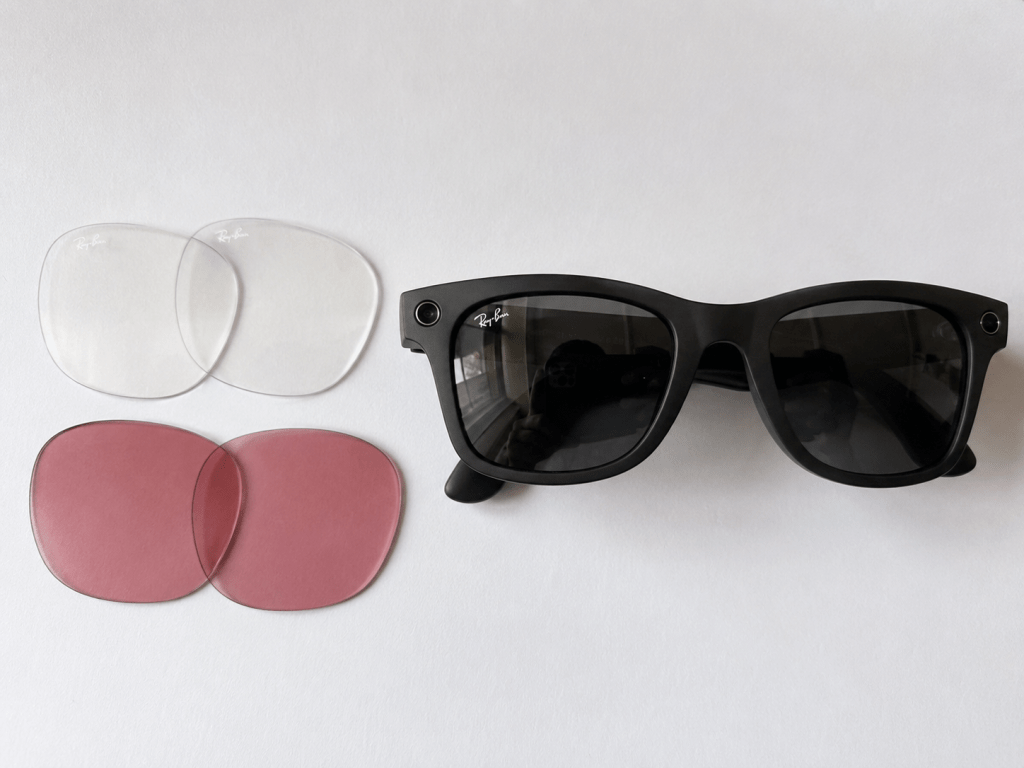
    A pair of Ray-Ban Meta smart glasses with the dark lenses installed, and clear and pink replacement lenses lying beside them, ready to be swapped in.

    Then I found replacement lenses online. The ones I bought were around $20 to $30, and I can swap them with a firm thumb push.

    I have clear lenses, dark lenses, and a rose-colored pair. The rose tint can help with contrast and glare. Even though I am blind, I still use the vision I have in some situations.

    I would also never buy them for a blind person as a surprise gift. They require charging and setup. Some people do not want to deal with this kind of technology at all.

    Said person should get a say before expensive technology shows up as a gift.

    Would I buy them again?

    Yes.

    They do not replace my phone and they are not a set of working eyeballs.

    But I keep reaching for them.

    They have stayed in rotation.

    That is probably my most honest review.

    Note: This is not a sponsored post, and it is not a technical review. It is just how the Ray-Ban Meta smart glasses have worked for me.

    Want a more detailed, technical review?

    If you want a deeper, more technical look, these are the best reviews I’ve found written for a blind and low-vision audience:

  • Feeding the masses 🐶🐶🐶🐱

    Feeding the masses 🐶🐶🐶🐱

    We have four indoor animals.

    Three dogs.

    Hogan, a black-and-white cat with green eyes, resting on a grey bed with one white paw stretched forward, gazing toward the camera.

    One cat.

    Feeding them has become… a system.

    Mostly because I’m blind.

    If everything looks the same, eventually I’m going to grab the wrong thing. So I don’t make everything the same.

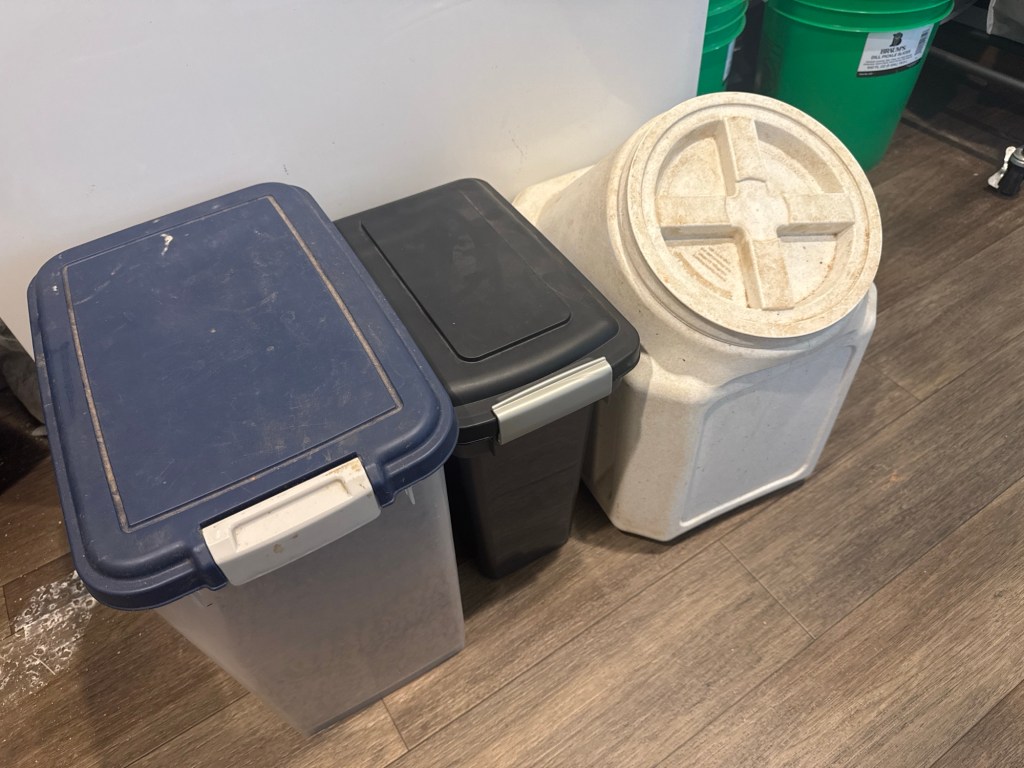
    Three different pet-food storage bins lined up on a wood floor against a white wall — a navy rectangular bin, a black rectangular bin, and a round cream-colored bin with a screw-top lid — each a different shape and size, with a green bin behind them.

    Hogan’s cat food is in a different container than the dogs’. Different shape. Different size.

    Works for me.

    Heloise is almost eleven.

    She’s had more than a dozen teeth removed over the years, so every now and then we call her Fourteen Teeth.

    She still has plenty of opinions.

    I bought her a slow feeder bowl.

    Then Hoss got one.

    Then Hondo.

    Now everybody eats a little slower.

    We’re also trying a couple of puzzle toys.

    The jury’s still out. The dogs seem interested. I like that dinner lasts longer than thirty seconds.

    Hoss is the one with the sensitive stomach.

    Food matters.

    Treats matter too.

    We’ve learned that one the expensive way.

    Hondo, on the other hand, has never met a meal he didn’t think should be finished immediately.

    Being blind changes how I notice things.

    I don’t watch them eat.

    I listen.

    I notice who’s still crunching.

    Who’s already checking somebody else’s bowl.

    Who’s asking to go outside again.

    And yes…

    Sometimes I know somebody’s stomach isn’t happy before anyone else in the house.

    Hondo isn’t subtle.

    None of this is complicated.

    It’s just a bunch of little systems that make life easier.

    For me.

    And I think for them too.

    Things we’re using lately:

    • Slow feeder bowls
    • Puzzle toys (still testing these)
    • Food for Hoss’s sensitive stomach
    • Separate food containers for Hogan and the dogs

    If you’re curious about the slow feeder bowls or anything else we use around here, I keep them all on my Gear I Use page.

    As an Amazon Associate I earn from qualifying purchases, at no extra cost to you.

  • Chicken hatching 🐣 from my closet!

    Chicken hatching 🐣 from my closet!

    This post contains an affiliate link. If you purchase through it, I may earn a small commission at no extra cost to you.

    Chicken Incubators Assume You Can See

    Most people hear “blind” and immediately lower the difficulty setting on what they think my life looks like.

    Some people are genuinely surprised I can cook dinner, raise kids, keep animals alive, or work full time without accidentally wandering into traffic.

    The truth is, blindness changes a lot of things. But it usually doesn’t change things in the ways people expect.

    Some of the stories you’re going to read here are probably going to sound a little ridiculous.

    So with that in mind, let’s get into today’s chaos.

    I have a leghorn that I absolutely love. She was part of the first five chickens I ever got when we started our flock. She’s solid white, and her name is Mrs. Black.

    Not the smartest chicken, bless her heart, but she follows me around like a little dog and yells at me if I’m late bringing snacks.

    After being heavily influenced by other chicken people online, I eventually bought an incubator and got the bright idea that I should probably hatch eggs myself. (This is the incubator I used — Harris Farms Nurture Right 360.)

    That’s how I discovered that chicken incubators are apparently designed with the bold assumption that the person using them can actually see the display.

    There are basically three things you need to monitor when you’re incubating eggs: humidity, temperature, and how many days the eggs have been in there.

    All of which, of course, are displayed on a tiny digital screen on top of the incubator.

    So naturally I started engineering my own accessibility features.

    First, I moved the incubator into my closet because my dogs absolutely could not be trusted around what was essentially a warm plastic box full of future chicken nuggets.

    Then I bought a Bluetooth thermometer that connected to my phone so I could monitor the humidity and temperature inside the incubator without needing to read the built-in display.

    The humidity tray inside the incubator also needed regular refilling.

    Thankfully, there was a tiny external fill port for the humidity reservoir, so I used a cup of water and a small plastic tube to refill it from outside the incubator.

    And somehow it worked.

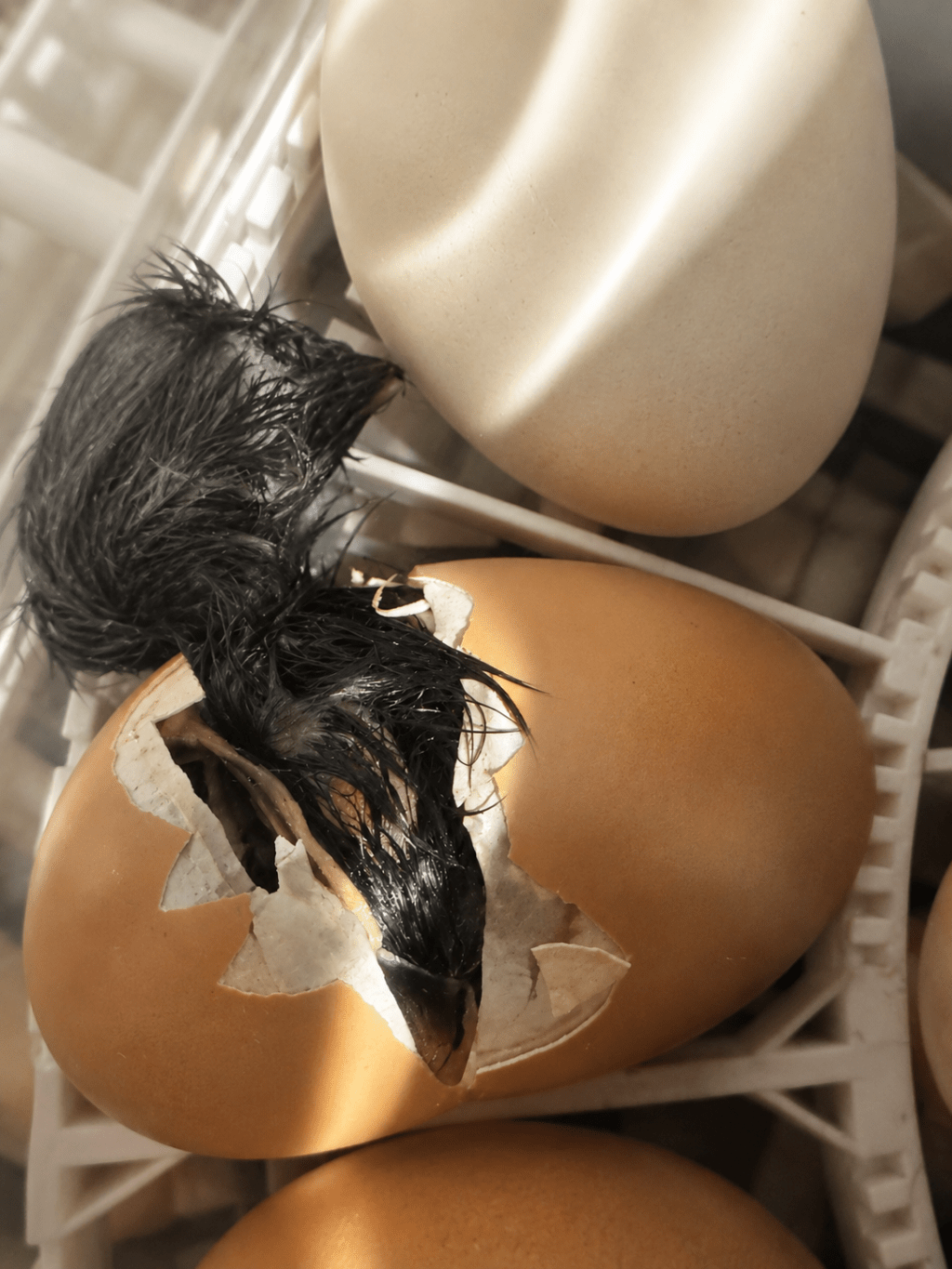
    Out of 21 eggs, 14 hatched successfully.

    At around three in the morning, my closet started peeping at me, which turns out to be a very effective auditory notification system for newly hatched chicks.

    So now, against all reasonable expectations, I apparently hatch chickens.

    Mrs. Black and her sisters seem pretty proud of themselves about the whole thing.