
A lot of what makes my house accessible for me would not look like much to anyone else.
I use plenty of technology. I like smart devices when they actually make my life easier. But a lot of the most reliable accessibility in my house is cheap, low-tech, and already sitting in a drawer somewhere.
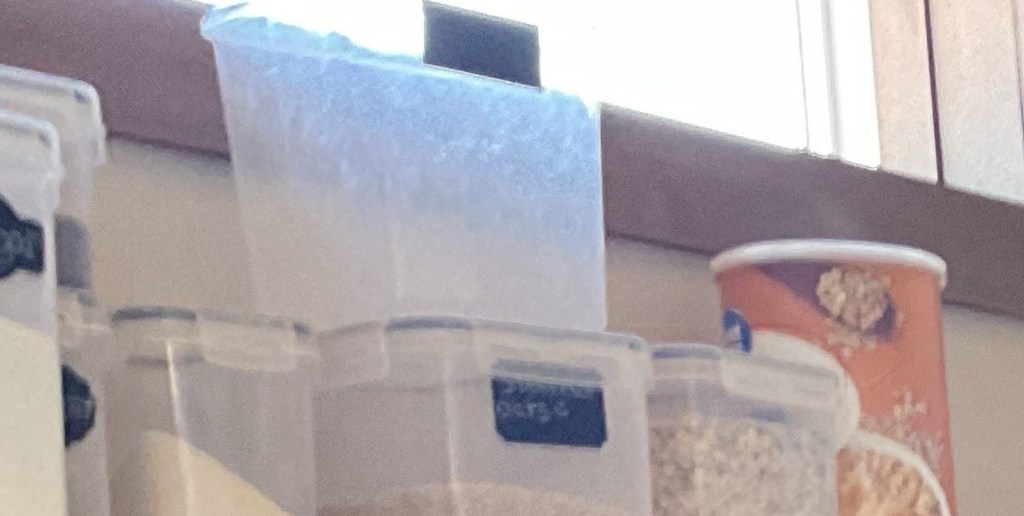
It is not always a smart device that speaks to me. Or even a braille label. Sometimes it is a rubber band around the conditioner so I do not wash my hair twice and condition it zero times. Often it is a container that does not match the others on purpose.
The uniform pantry aesthetic will never be my reality. A beautiful row of identical containers may look organized, but if they all feel the same, I am going to mix them up eventually.
I once mistook leftover mashed potatoes for sour cream.
Ten out of ten, do not recommend.
If It All Feels the Same, I’ll Mix It Up
That is why I use bump dots, rubber bands, odd containers, and routine.
Putting things back is its own thing. It is not just a good habit. It is how I make sure I can find the thing again. A charger moved to a “better” spot. An ingredient set down somewhere creative.
That can stop a project cold.
I have heard whispered rumors that it is possible to train an entire household to put everything back exactly where it belongs. I cannot verify this. So I build systems around the things that are mine to manage.
Smart Is Nice. Independent Is Better.
I am not anti-smart-device. I like them when they make my life easier.
My thermostat works well. The app is accessible, and I can control it from my phone. My Ring devices are useful too. They give me useful audio alerts, and the app works well with VoiceOver.
Then there is my oven.
It is smart. Technically.
I can set it from my phone, but before I can use the app, I have to press a smart button on the flat control panel.
That is not really accessible. That is the accessible part hiding behind the inaccessible part.
That is usually my test.
Can I use it without calling someone over?
A Few Low-Tech Things That Help
So: rubber bands, different clips for different bags, and a rule that the thing goes back where it lives.
I also use bump dots, especially the really small ones. Some are sold as Loc-Dots. They are nice on flat panel appliances.
Can I feel it, locate it by routine, or control it without guessing? If not, I need to change something.
Good places to start are bottles that feel alike, flat appliance panels, food containers, chargers, remotes, and anything people keep moving.
I’ll write more about labeling separately, because that is its own whole subject.
For now, that is the main idea. Accessible does not have to mean expensive or impressive. A lot of the time, it just has to be reliable.
Resources
Quick note: this is just my opinion and what I do in my own house. Different things work for different blind and low vision people. Yes, I should probably braille label more things than I actually do. Sometimes I do. Often, I grab a rubber band and move on with my life.
For more thorough organizing and labeling ideas, these are good places to start:
- APH ConnectCenter / VisionAware has a guide, Labeling and Marking: A Guide for Low Vision and Blindness. It covers practical ways to mark household items, clothing, medication, and other things you may need to identify by touch, large print, braille, or other methods.
- Hadley has a podcast episode, Getting Organized After Vision Loss. It talks through routines and habits that can help people stay organized, less stressed, and safer at home after vision loss.
 that blind chicken lady
Leave a comment